
Fighting the Yellow-Legged Hornet: Our Front-Line Battle Featured in The New York Times
The Lowcountry is known for its beautiful beaches, world-class golf courses, and stunning coastal landscapes. But lately, a new and aggressive visitor has been making headlines—and not the good kind.
If you happened to open The New York Times recently, you might have spotted a familiar name. Hilton Head Exterminators was featured in a front-page science article detailing the state’s ongoing battle against the invasive yellow-legged hornet (Vespa velutina).
As local pest control experts, being recognized on a national stage is an honor, but the reason behind it is a serious matter for our local ecosystem. These predatory insects are spreading rapidly across our region, posing a massive threat to our native honeybee populations and local agriculture.
Here’s a closer look at what is happening right in our backyard, why these pests are so dangerous, and how our team is working on the front lines to protect the Lowcountry.
The Threat to Our Lowcountry Honeybees
Native to Southeast Asia, the yellow-legged hornet first surfaced in the United States in late 2023 near the Port of Savannah before making its way across the river into South Carolina. With our balmy climate and abundant local bee colonies, the Lowcountry has unfortunately become an ideal environment for them to thrive.
Unlike native wasps or yellowjackets, yellow-legged hornets are uniquely destructive. They specialize in hunting honeybees by hovering directly outside beehives like tiny helicopters. When an unsuspecting bee flies out, the hornet snatches it mid-air and physically dismantles it to take the nutrient-rich abdomen back to its nest.
Because our local honeybees didn’t evolve alongside these predators, they have no natural defense mechanisms. When a hive comes under attack, the bees typically refuse to leave their nest out of fear, causing the resources inside to dwindle and the entire colony to eventually collapse.
The Lifecycle of a Hornet Nest
To effectively manage these pests, it helps to understand how they grow. Clemson University’s Department of Plant Industry, led by apiary inspector Brad Cavin, has been spearheading the tracking effort.
They have mapped out exactly how these hornets establish themselves throughout the year:
- Spring (Embryo Nest): In early spring, an emerging queen builds a small, Ping-Pong ball-sized embryo nest to raise her first generation of workers.
- Early Summer (Primary Nest): Once the colony grows, they build a cantaloupe-to-basketball-sized primary nest. These are frequently found close to the ground, inside irrigation or sprinkler valve boxes, or tucked under the eaves of homes and maintenance sheds.
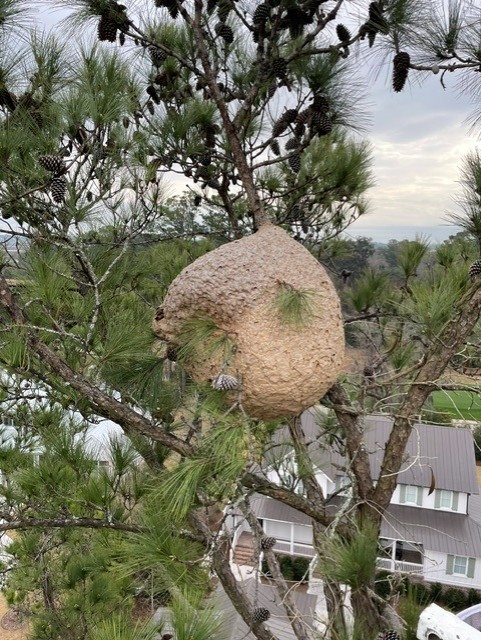
- Late Summer/Fall (Secondary Nest): As population numbers surge into the thousands, the hornets move high up into the treetops to build massive secondary nests that can easily grow larger than a beach ball.
How Hilton Head Exterminators Handles the Buzz
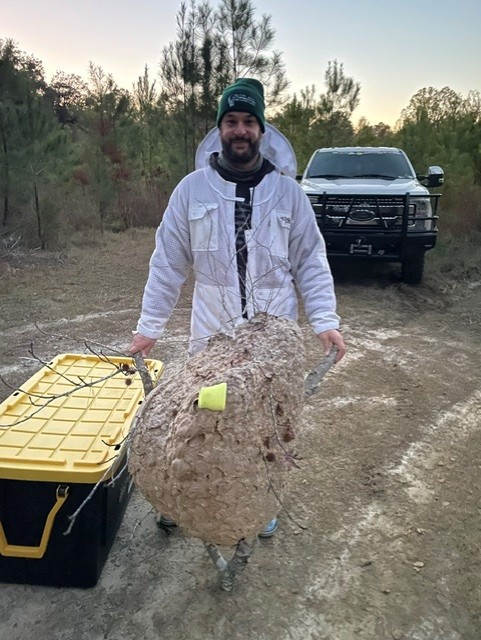
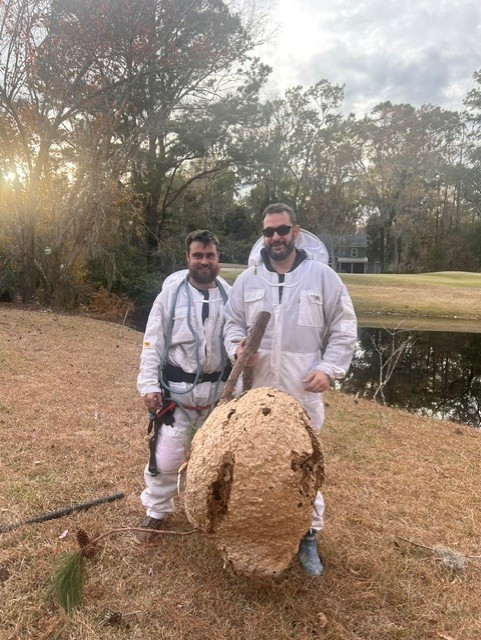
When the state’s tracking teams locate a confirmed hornet nest on a residential or commercial property, they call in removal specialists. The New York Times highlighted our very own Nathan Krelis and Wes Long, who have successfully removed hundreds of these nests across the region, including one massive colony last summer that reached the size of a car engine.
Dealing with an active yellow-legged hornet nest requires incredibly steady nerves and specialized equipment. When a nest is disturbed, the insects swarm aggressively, creating a deafening buzz.
To handle this safely and responsibly, our technicians suit up in heavy-duty protective beekeeping gear. Instead of broadly spraying heavy pesticides into the surrounding environment, our team uses a highly targeted approach: we plug the nest’s main entrance with a small, treated sponge. This self-contained approach neutralizes the colony safely within the nest structure.
Once the swarm stops, the nest is carefully scraped down, bagged, and handed over to state officials for freezing, drying, and research.
Safeguarding Your Property
While state agencies and local teams are working around the clock, community awareness is our best line of defense. Because primary nests are usually built on residential properties (under rooflines, storefront awnings, or sheds), it’s highly possible to encounter one during ordinary yard work or outdoor maintenance.
If you notice a suspicious, swirling-patterned paper nest on your property or see unusually large hornets hovering around flowers and structures, don’t attempt to spray or remove it yourself. These hornets possess a venomous sting and will defend their home aggressively.
Instead, rely on professional intervention. You can explore our comprehensive pest control services to see how we protect local homes, find answers to common regional pest questions on our FAQ page, or learn more about our targeted treatments for flying and stinging insects by visiting our insect control page.
We live and work in this beautiful coastal paradise, and we remain fully committed to protecting our neighbors, our environment, and our vital local honeybees from invasive threats.
To schedule your yellow-legged hornet control and removal service, request a quote today.